
How to Sabbatical II: Practical Considerations
By Guli Fager, MPH, CFP®, Financial Advisor
One: Can I Even Afford It?
I’ll go into a lot more detail about this later, but I use eMoney[1] for my own financial planning. In Toler Financial Group’s financial planning process, when clients come to us with questions about how to absorb a new, big expense (like a baby starting daycare, for example), we always ask clients to review their most recent 90 days of spending and make any relevant updates to living expenses. Since I bought a house this year, I knew I needed to confirm whether my spending estimates in eMoney were accurately reflecting some of the new costs I’ve taken on. Once I did that, I put in the cost of the trip to see if I could possibly afford it.
I anticipate spending about $30,000 on the trip, including a new bike, travel to San Diego and from St. Augustine, meals, insurance, clothing and gear I’ll need, as well as a few weeks of unpaid time off after I use up all my PTO[2]. I split the cost into $15k in 2025 and again in 2026 (though I’m not sure it’ll be hit exactly that way) and, with my income and anticipated bonuses, the 5 year cash flow projection suggested this plan was going to work for me.
What this projection told me was that while I could afford it without going into the red, essentially every “overflow” dollar I have this year and next will be spent on this trip. My regular income (not including bonuses) is pretty much all accounted for between regular expenses and retirement plan contributions, so this means that I have to carefully weigh expenses that are NOT related to this trip. If I needed the extra cash flow for the next few months, I would have been comfortable reducing my retirement plan contributions temporarily to just get the full match TFG offers, but it doesn’t look like I’ll need to make that tradeoff[3].
As I was making these calculations, I had about $500 of fall shopping in my Anthropologie[4] cart and realized: this is one day of the bike trip. I can buy new jeans when I get back (I might need to!). Not everyone would want to spend every extra dollar they’ll have on one big experience, so projecting the costs against income - and other needs that might come up in the meantime - is important.
Two: Will My Boss Let Me Go?
Many jobs just flatly do not have the flexibility to let employees take significant time off, even if they could afford to go without income for a time and/or spend a bunch of money on a big trip. I have a great boss (many of you reading this already know that!) who is a believer in the importance of time off and doing hard things. I felt confident that she would support the idea of this trip, but I knew I needed to check whether there were any drop dead events during the timeframe I was proposing to be gone before I paid a deposit. March and April are good months to leave because nobody else had vacations planned, and this way I’ve got good coverage while I’m away and I’ll be able to hold down the fort when colleagues want to go away themselves in the summer because I’ll be all out of vacation time :) Tax day will fall during this time, but I can proactively send clients tax forms before I leave. She said yes :)
Three: Will I Actually Enjoy it?
Even though I have done several 100+ mile rides, those events are over in one day. Would I actually like biking for almost 60 days in a row, and how would my body adapt? In triathlon training you don’t usually bike two days in a row. So I went on a 5 day gravel biking trip this summer with Trek Travel[5], where the mileage was lower than what I’m used to but the elevation gain really intense. Physically the trip was challenging but really fun to be with a group of people who were doing the same thing. Once I tested the hypothesis that I would enjoy biking day after day, I knew I needed a training plan.
I started using my trainer more, riding two days in a row, and doing long rides on the weekends, but I was just sort of winging it. I trained for and completed an Ironman in 2024, so I know that I have the capacity to comply with a months-long training regimen, but I also know I need a coach and a training plan — the brainpower required to come up with the exercise plan to accomplish something like this is beyond me. If I don’t know at the beginning of a workout what the goal is, how long it’s supposed to be, and how hard to make it, I get bored after about 45 minutes (see below). The triathlon coach I’ve worked with for all of my races - Ryan Falkenrath of Set the Pace Triathlon[6] — was amazing, but training for a 60 day 3300-mile trip is a different animal than a single 140.6 -mile day, so I found a different coach, Tom Murray of Vision Quest Coaching[7] in Chicago (more on Tom later).
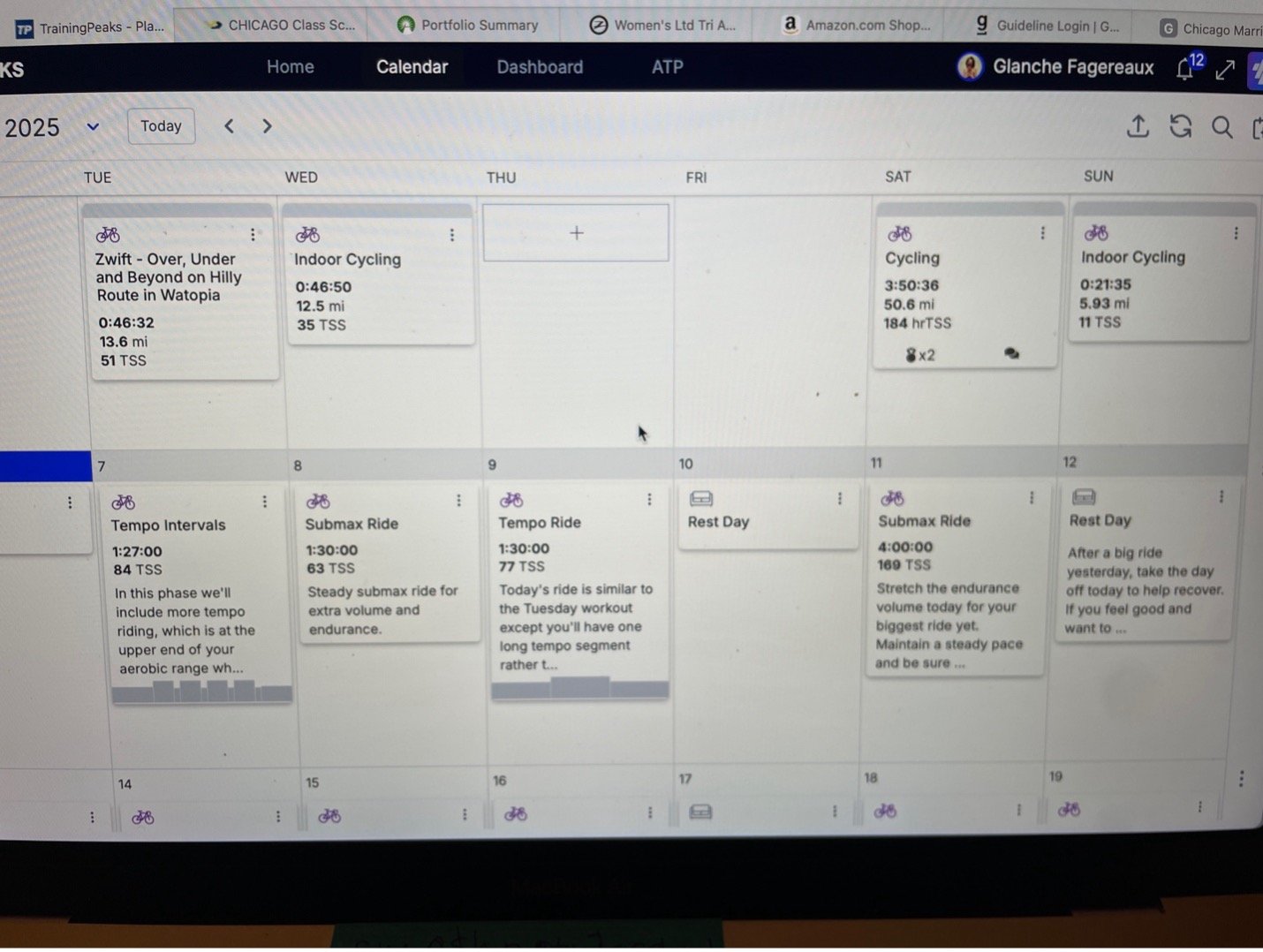
You can see the difference between what I was doing on my own compared to what I did once I got the training plan; once the workouts my coach put together for me showed up in Training Peaks and Zwift (the simulator program for my smart trainer), I had no problem riding for 90 minutes inside; but on my own, I tapped out after less than an hour.
Now that I’m a few weeks into the new training plan, I’m ready for the next big thing — buying a new bike. Next week, thoughts on budgeting for gear.[8]
[1] References are for illustration only; no affiliation or endorsement is implied.
[2] Decisions affecting pay, taxes or benefits should be reviewed with your tax pro & HR.
[3] Changes to retirement plan contributions can have a potential impact on long-term savings & taxes.
[4] References are for illustration only; no affiliation or endorsement is implied.
[5] References are for illustration only; no affiliation or endorsement is implied.
[6] Ibid.
[7] Ibid.
[8] This is a personal narrative for educational purposes only and isn’t individualized advice. Your situation may differ.
Cross-Country Bike Tour & Sabbatical Planning FAQ
How do you know if you can afford to take a sabbatical?
The best place to start is with a realistic financial plan. Review your recent spending, update your monthly living expenses, estimate the total cost of your trip, and project how those expenses will affect your cash flow. A financial planning tool or detailed budget can help you determine whether a sabbatical is financially sustainable before making any commitments.
How much does a cross-country bike tour cost?
The cost varies depending on your route, equipment, lodging, and travel style. For my own two-month ride from San Diego to St. Augustine, I estimate spending approximately $30,000. That includes a new touring bike, airfare, meals, lodging, insurance, cycling gear, clothing, transportation, and several weeks of unpaid leave from work.
How do you budget for a long-distance cycling trip?
Start by identifying every major expense—not just the bike itself. Consider travel to and from your starting and ending points, equipment upgrades, replacement gear, food, lodging, insurance, maintenance, and lost income if you'll be taking unpaid time off. Looking at the full financial picture makes it easier to decide whether the experience aligns with your priorities.
Should you stop saving for retirement to fund a sabbatical?
That depends on your individual financial situation. Some people may temporarily reduce retirement contributions to improve cash flow, while others may decide to keep investing at their current rate. Any changes should be weighed carefully, considering both long-term financial goals and the value of the experience you're planning.
What financial sacrifices might a sabbatical require?
For many people, a major adventure means delaying other discretionary spending. Seeing the total cost of a trip in the context of everyday purchases can make financial tradeoffs clearer. A sabbatical often becomes less about finding extra money and more about deciding what experiences are most important over the next year or two.
How do you ask your employer for a sabbatical?
Timing and preparation matter. Before requesting extended leave, consider your organization's workload, seasonal demands, and how your responsibilities will be covered while you're away. Presenting a thoughtful plan that minimizes disruption can increase the likelihood of receiving approval.
Can you take unpaid leave to travel?
Many employers offer some flexibility through unpaid leave, extended vacation, or negotiated career breaks, although policies vary widely. If your role allows it, planning well in advance gives both you and your employer time to prepare.
How do you know if you'll actually enjoy a cross-country bike tour?
Before committing to several thousand miles, it helps to test the lifestyle. A shorter multi-day cycling trip can answer important questions about how your body responds to consecutive days of riding, whether you enjoy life on the bike, and what equipment or routines need to change before a longer adventure.
How do you train for a cross-country bike tour?
Unlike training for a single endurance event, bicycle touring requires preparing your body to ride day after day. That often means increasing weekly riding volume, practicing back-to-back rides, building endurance over several months, and learning how to recover while continuing to ride.
Is training for bike touring different from training for an Ironman?
Yes. An Ironman is designed around peak performance on a single day. A cross-country bike tour requires sustained endurance over weeks or months, with an emphasis on recovery, consistency, and managing fatigue rather than maximizing speed.
Do you need a coach to prepare for a long-distance bike tour?
Not everyone does, but many cyclists benefit from having a structured training plan. A coach can tailor workouts to your goals, provide progression over time, and remove the guesswork from training. For many athletes, following a clear plan is easier than designing one from scratch.
Why is a structured cycling training plan important?
Having a defined workout—with a purpose, duration, and intensity—can improve both consistency and motivation. A structured training plan also helps build confidence by ensuring each workout contributes toward the larger goal instead of simply accumulating miles.
What equipment should you buy first for a cross-country bike trip?
Once you've confirmed the trip is financially feasible, secured time away from work, and begun training, the next major investment is typically the bike itself. Choosing the right touring or endurance bike creates the foundation for selecting gear, bags, clothing, and other equipment needed for the journey.
What are the three biggest questions to answer before taking a sabbatical?
Every extended adventure starts with three practical questions:
Can I afford it?
Can I take the necessary time away from work?
Will I actually enjoy the experience enough to justify the investment?
Answering those questions honestly creates a strong foundation for planning everything that follows.